How to Calculate Percentage Increase or Decrease
Published: 10 Jul 2026
Whether you’re comparing prices, tracking a pay raise, or reviewing sales numbers, knowing how to calculate percentage increase or decrease between two numbers is a genuinely useful skill. The formula itself is simple, but it’s also easy to mix up which number goes where. This guide walks you through the exact steps, a clear example, and a quick way to skip the math entirely when you’re in a hurry.
Calculating Percentage Change Step by Step
Percentage change follows one consistent formula, no matter what you’re comparing. This section breaks it down clearly so you can apply it confidently to any two numbers.
Step 1: Identify Your Starting and Ending Numbers
Before calculating anything, clearly identify which number is your starting point and which is your ending point. This matters because percentage change is always measured relative to the original number. Mixing these up is the most common reason people get an incorrect result.
Step 2: Find the Difference Between the Two Numbers
Subtract the starting number from the ending number to find the raw difference. If the ending number is larger, this difference will be positive, indicating an increase. If it’s smaller, the difference will be negative, indicating a decrease.
Step 3: Divide the Difference by the Original Number
Take the difference you calculated and divide it by the original starting number, not the ending number. This step is where most manual calculation mistakes happen, since dividing by the wrong number changes the entire result. Always divide by the number you started with.
Step 4: Multiply by 100 to Get a Percentage
Multiply your result from the previous step by 100 to convert it into a percentage. This final number tells you exactly how much the value increased or decreased, expressed as a percentage of the original amount.
A Simple Example Walkthrough
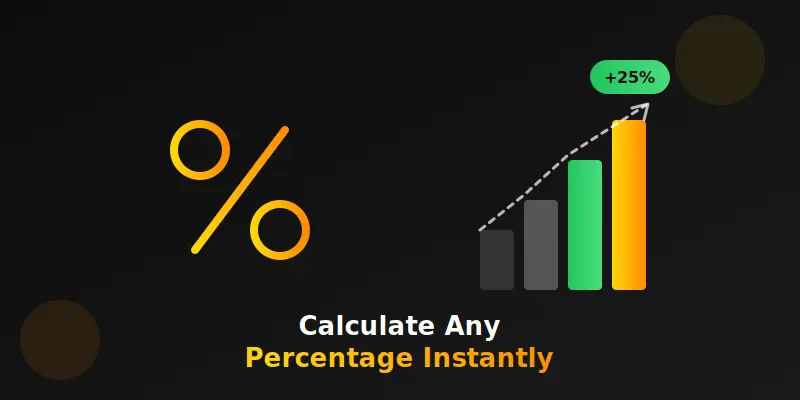
Suppose a product’s price went from $80 to $100. The difference is $20, and dividing that by the original $80 gives 0.25. Multiplying by 100 gives a 25% increase, meaning the price rose by exactly one quarter of its original value.
What a Negative Result Means
If your final percentage comes out negative, it simply means the value decreased rather than increased. For example, going from $100 to $80 gives a difference of negative $20, which works out to a 20% decrease. The negative sign is expected and doesn’t indicate an error in your math.
Why the Order of Numbers Matters So Much
Percentage change is not symmetrical, meaning a 25% increase from 80 to 100 is not undone by a 25% decrease back to 80. This is because the decrease would be calculated from the new number, 100, not the original 80. Understanding this prevents confusion when comparing repeated percentage changes.
Common Mistakes to Avoid
Dividing by the ending number instead of the starting number is the most frequent error in this calculation. Forgetting to multiply by 100 is another common mistake that leaves the answer as a decimal instead of a percentage. Taking it one step at a time helps avoid both issues.
When You’ll Use This Calculation in Real Life
This formula comes up constantly, from comparing prices and calculating raises to tracking business growth and investment returns. Understanding it once means you can apply it confidently to almost any situation involving two numbers over time. It’s one of the most practical everyday math skills to have.
Skip the Manual Math
If you’d rather not calculate this by hand every time, there’s a much faster option. Use our free percentage calculator online to instantly find percentage increase or decrease between any two numbers. Just enter your starting and ending values, and get your answer immediately.
Conclusion
Knowing how to calculate percentage increase or decrease between two numbers is a simple but genuinely useful skill for everyday life, from comparing prices to tracking growth. Remember to always divide by the original number, not the new one, to get an accurate result. My honest recommendation is to practice the manual method a few times, then rely on our free percentage calculator online whenever you need a fast, reliable answer. Give it a try now, and check out our other simple tools for everyday calculations.
FAQs:
Subtract the original number from the new number, divide that difference by the original number, then multiply by 100. This gives you the percentage change between the two values.
Using a free online percentage calculator is the fastest and most reliable method. It removes the risk of manual calculation errors and gives an instant result.




- Be Respectful
- Stay Relevant
- Stay Positive
- True Feedback
- Encourage Discussion
- Avoid Spamming
- No Fake News
- Don't Copy-Paste
- No Personal Attacks
- Be Respectful
- Stay Relevant
- Stay Positive
- True Feedback
- Encourage Discussion
- Avoid Spamming
- No Fake News
- Don't Copy-Paste
- No Personal Attacks
