How to Improve Your Typing Speed: A Simple Guide for Beginners
Published: 7 Jul 2026
Do you ever feel like typing is taking up more of your day than it should? Maybe you’re staring at the screen, hunting for the right keys, while your thoughts move faster than your fingers. The truth is, most people never learn proper typing habits, and that’s exactly why their speed stays stuck for years. The good part is, this is one of the easiest skills to fix once you know what to focus on. In this guide, we’ll walk through exactly why typing speed matters, what a good speed actually looks like, and simple habits that can help you type faster without feeling like you’re forcing it.
Why Does Typing Speed Actually Matter?
It’s easy to assume typing speed only matters for typists or data entry jobs, but that’s not really true anymore. Almost everything we do today involves a keyboard in some way.
- At work, faster typing means you finish emails, reports, and documents quicker, leaving more time for actual thinking instead of hunting for letters.
- In school or college, assignments and notes get done faster, so you’re not rushing at the last minute.
- For freelancers, many online jobs directly depend on typing speed, especially content writing, transcription, and virtual assistant roles.
- In daily life, from searching online to messaging friends, typing is something we do constantly without even noticing it.
Once you start typing faster, you’ll notice you’re mentally less tired too, since you’re not stopping every few seconds to find a key or fix a mistake.
What Counts as a Good Typing Speed?
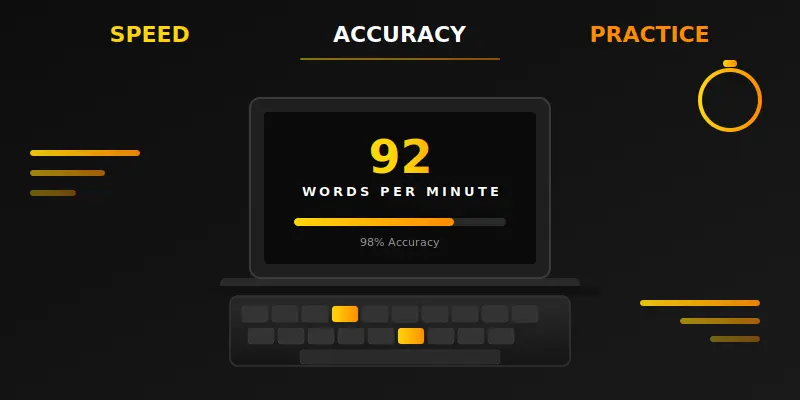
Typing speed is measured in Words Per Minute (WPM), along with an accuracy percentage. Here’s a simple way to understand where you might currently stand:
- Beginner – 20 to 30 WPM
- Average typist – 30 to 45 WPM
- Above average – 45 to 65 WPM
- Professional level – 65 to 90 WPM
- Expert typist – 90+ WPM
Most jobs that require typing usually expect somewhere around 40 to 50 WPM, along with at least 95% accuracy. So if you’re aiming for a job like that, this is a realistic target to work toward.
Simple Habits That Actually Help You Type Faster
You don’t need any expensive course or fancy keyboard to improve your typing. Small, consistent habits make the biggest difference over time.
1. Learn where your fingers should rest. Keep your fingers resting lightly on the middle row of the keyboard (A, S, D, F on the left and J, K, L on the right). This gives every finger a “home,” so it always knows how far to stretch for any key.
2. Try not to look down at the keyboard. This is probably the biggest habit slowing most people down. It feels strange at first, but the less you look down, the faster your fingers learn the keys on their own.
3. Focus on getting it right, not just fast. This one surprises people, but speed comes naturally once your mistakes go down. If you’re constantly hitting backspace, you’re actually typing slower overall, even if your fingers are moving quickly.
4. Practice a little bit daily. You don’t need long sessions. Ten to fifteen minutes a day, done consistently, works far better than one long session once a week.
5. Practice with real sentences, not random letters. Typing full sentences trains your fingers for actual writing, which is very different from just tapping random keys.
6. Check your progress from time to time. Without measuring your speed, it’s hard to know if you’re actually improving or just assuming you are.
7. Take short breaks when typing for long periods. Tired fingers make more mistakes. A short break every 20 to 30 minutes keeps your accuracy steady.
Test Your Typing Speed Right Now
Reading tips is helpful, but the real progress starts when you actually measure where you stand today. Our free Typing Speed Test tool lets you check your WPM and accuracy instantly, with no sign-up needed. You can choose a quick 15-second check or a longer 5-minute session, depending on how much time you have.
Try testing yourself once a week. Most people are surprised at how much their speed improves after just a few weeks of small, consistent practice.
Conclusion
Typing fast isn’t something you’re born with, it’s simply a habit built through small, repeated practice. Start with proper finger placement, avoid looking at the keyboard, and focus on accuracy before speed. Over time, these small changes add up to a noticeable difference in how quickly and comfortably you type. The best way to see your progress is to actually test it, so head over to our Typing Speed Test and see where you currently stand. Then come back every week or two to track how far you’ve come.
FAQs:
You can use our free Typing Speed Test tool to instantly check your WPM and accuracy without any sign-up or download required.
It’s best to avoid it. Looking down slows your progress because your fingers never fully learn the key positions on their own.
Most people notice a real difference within two to four weeks of practicing just 10 to 15 minutes daily. The key is consistency, not the length of each session.




- Be Respectful
- Stay Relevant
- Stay Positive
- True Feedback
- Encourage Discussion
- Avoid Spamming
- No Fake News
- Don't Copy-Paste
- No Personal Attacks
- Be Respectful
- Stay Relevant
- Stay Positive
- True Feedback
- Encourage Discussion
- Avoid Spamming
- No Fake News
- Don't Copy-Paste
- No Personal Attacks
